Stabilizing 3D Continuum-Arm Rollouts via Equilibrium Anchoring and Feature-Lifted Residual Learning
A hybrid predictor that separates steady-state anchoring from transient correction to keep long-horizon rollouts stable under actuation shift.

A hybrid predictor that separates steady-state anchoring from transient correction to keep long-horizon rollouts stable under actuation shift.
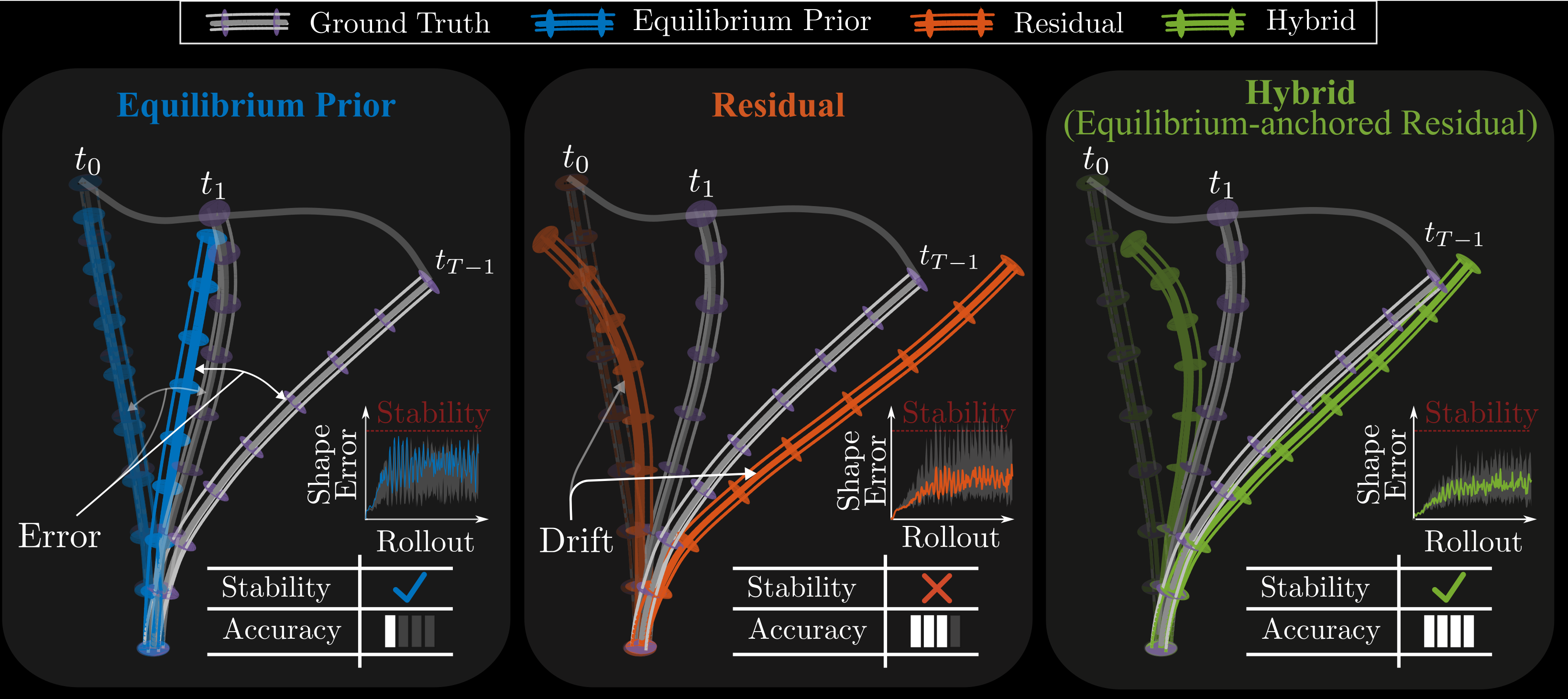
Multi-step motion prediction for continuum robots is difficult, especially under actuation distribution shift, where error accumulation can distort the predicted steady response and destabilize rollouts. This paper introduces a hybrid equilibrium-anchored residual-learning framework for a tendon-driven 3D continuum arm that makes steady behavior explicit. An equilibrium prior is learned from inexpensive static equilibrium data and used in a contractive update that continuously pulls predictions toward the equilibrium estimate, improving rollout stability. A lightweight feature-lifted residual model, linear in parameters, learns the remaining one-step mismatch from dynamic trajectory data, recovering transient dynamics. The approach is validated on 200-step simulation rollouts under stronger and faster actuation than in training, with an additional soft-tail hardware test under actuation-frequency shift. The Hybrid method reduces backbone position RMSE by 26% and tip position RMSE by 27%, producing consistent accuracy gains over prior-only and residual-only predictors while remaining stable across all tested trajectories. The same proposed model also improves robustness on standard nonlinear benchmarks against a combined Koopman baseline under matched evaluation protocols.
Unlike additive residual-Koopman models, our method explicitly separates steady-state anchoring from transient correction at every rollout step.
An actuation-conditioned equilibrium map is learned from inexpensive static equilibrium pairs and used in a contractive anchor update that pulls predictions toward physically plausible steady configurations, suppressing long-horizon drift.
A feature-lifted, linear-in-parameters residual is trained on anchored states—matching the distribution seen during open-loop rollout—to recover transient dynamics while retaining a control-friendly structure amenable to stability analysis.
Two datasets, two roles: static equilibrium data D2 for the anchor; dynamic trajectories D1 for the residual.
Fit a ridge-regression equilibrium map P(u) from 4,520 static equilibrium samples. At each rollout step, contract the predicted state toward P(uk) with strength β = 0.5.
Train a ridge-fit residual R(z) on anchored transitions to capture the one-step mismatch rk☆ = xk+1 − x̄k+1, recovering transient dynamics the anchor alone cannot model.
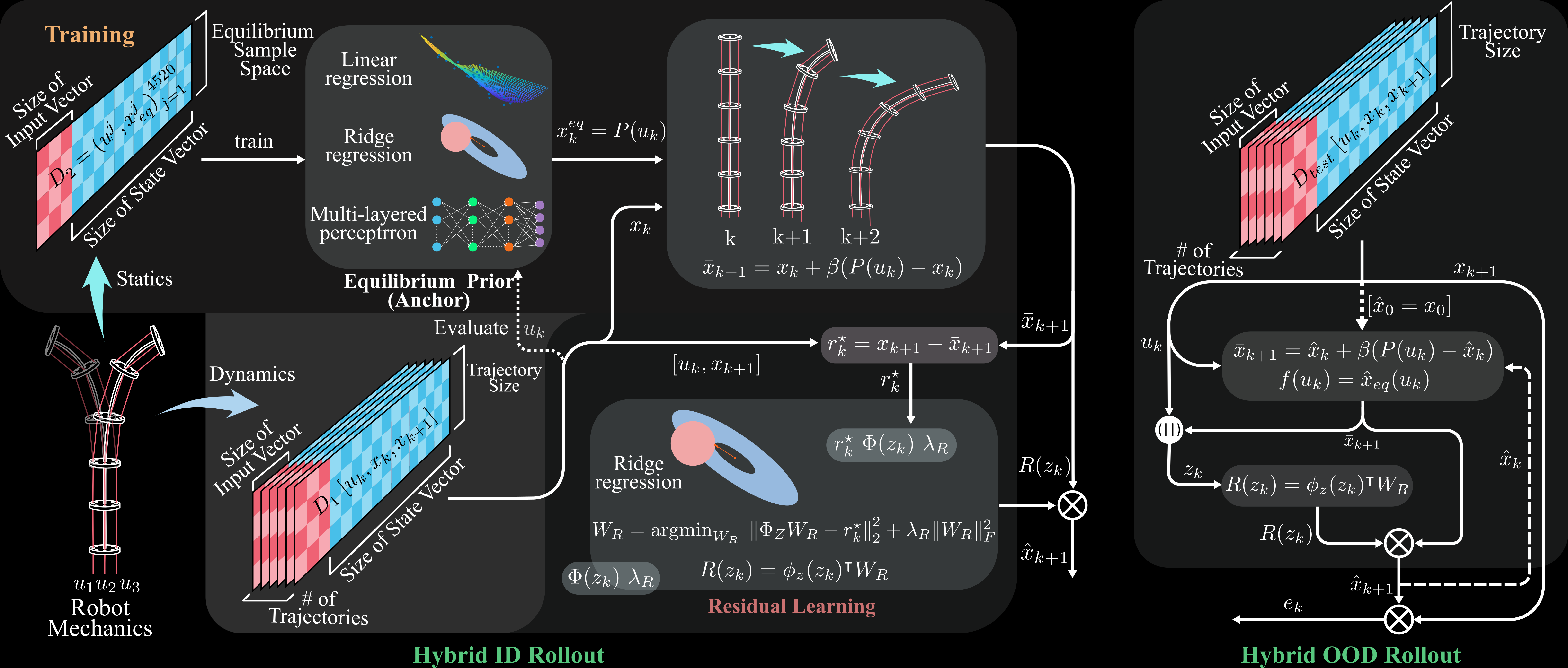
Framework overview. (a) Training: learn equilibrium prior P from static dataset D2, form anchored states, then fit residual R on dynamic dataset D1. (b) OOD rollout: iterate the anchored update plus residual correction for multi-step prediction.
Five predictors evaluated on identical 6 s (200-step) OOD rollouts with shifted actuation. Hybrid and Neural Hybrid achieve the lowest errors while remaining stable on every trajectory.
| Model | State RMSE | Backbone RMSE (cm) | Tip RMSE (cm) | Tip Orient. RMSE (°) |
|---|---|---|---|---|
| Equilibrium Prior | 2.513 | 15.32 | 26.10 | 41.63 |
| Neural Prior | 2.515 | 16.08 | 27.51 | 34.44 |
| Residual | 1.943 | 12.21 | 20.62 | 23.06 |
| Hybrid | 1.914 | 11.34 | 19.15 | 21.97 |
| Neural Hybrid | 1.900 | 11.29 | 19.06 | 24.20 |
OOD rollout RMSE over T = 200 steps on 19 test trajectories.
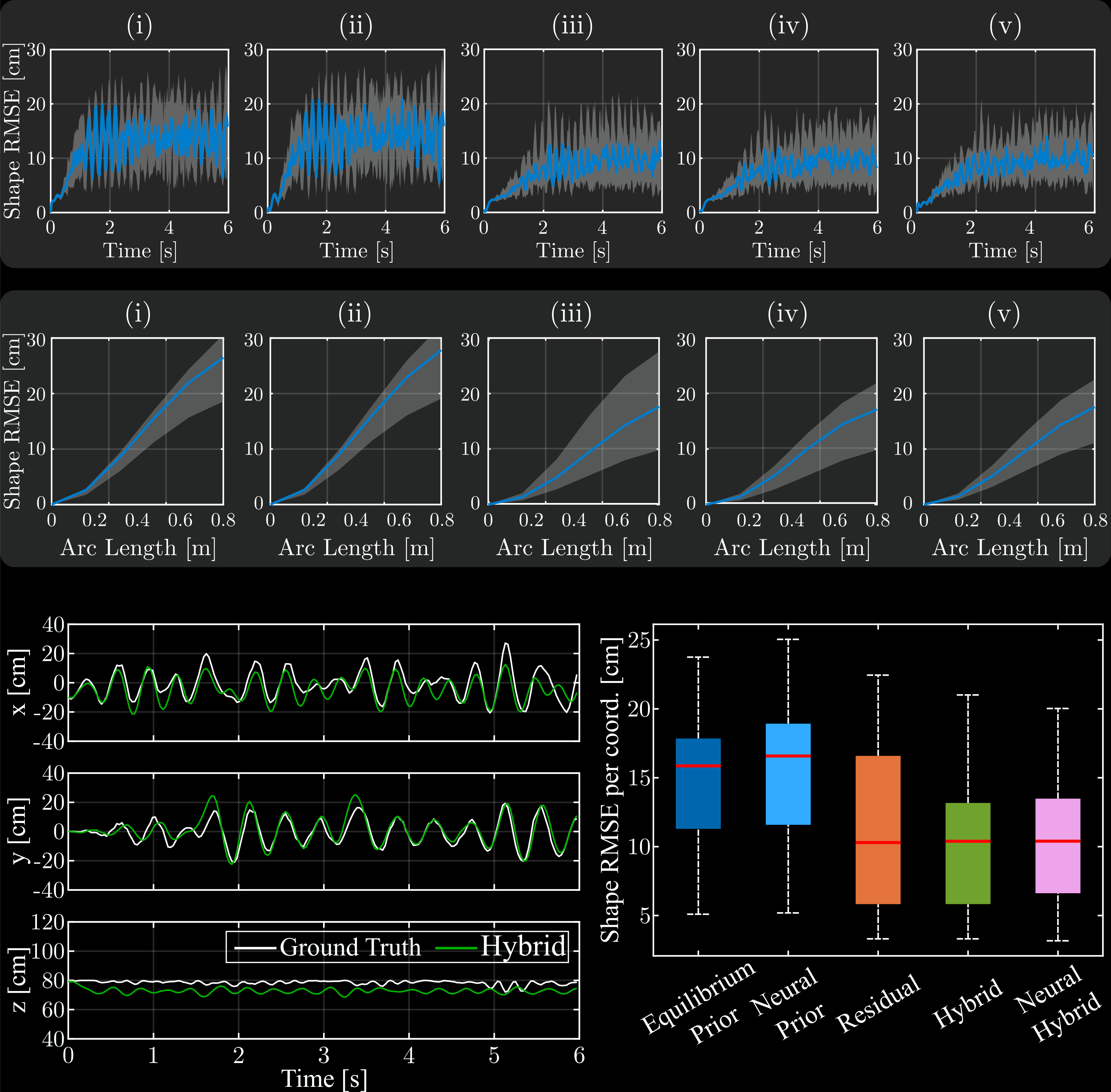
Rollout error. Median shape RMSE over the 6 s horizon and per-trajectory distribution. Hybrid achieves the lowest median with a compact interquartile range.
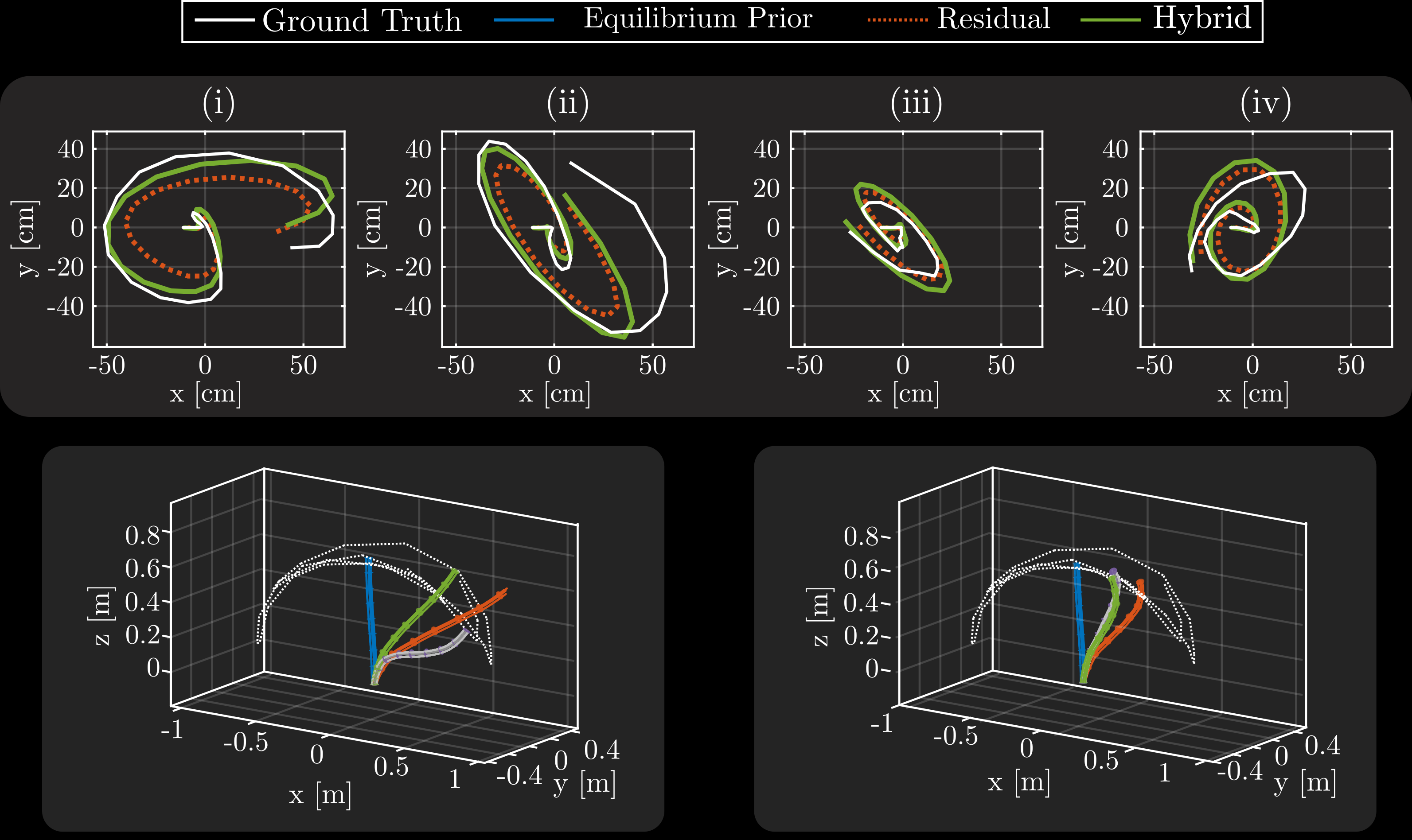
Qualitative comparison. Over 6 s, Hybrid stays close to ground truth while Residual can diverge to unphysical configurations under actuation shift.
Validated on a physical PneuNet soft tail under actuation-frequency shift, and on standard Van der Pol and pendulum-cart benchmarks against a residual-Koopman baseline.
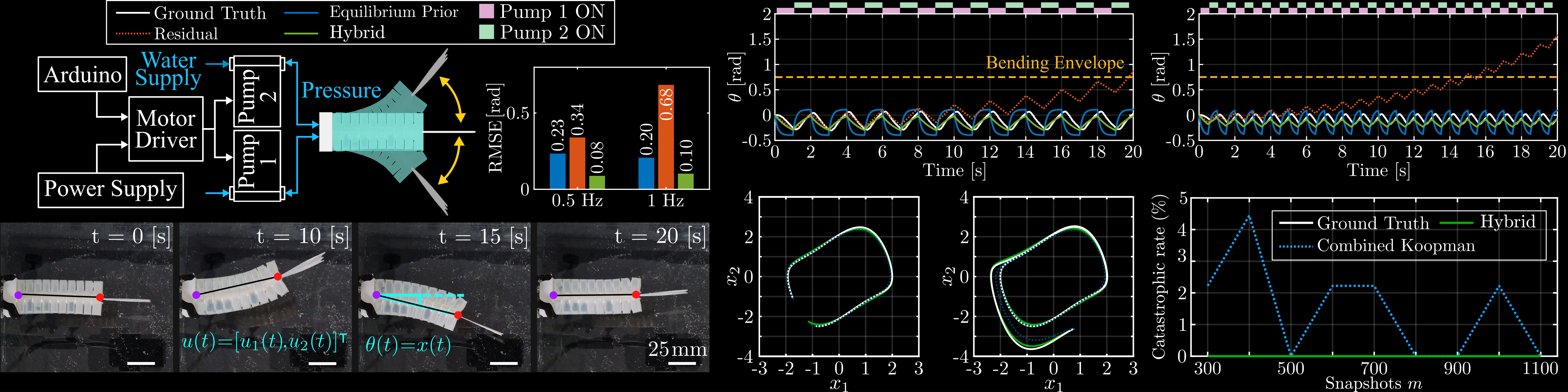
Beyond simulation. (a–h) PneuNet soft-tail experiments: Hybrid reduces mean RMSE by ≥51% vs. equilibrium prior and ≥74% vs. residual under frequency shift. (i–k) Van der Pol benchmark: Hybrid maintains 0% catastrophic rollout rate while the Koopman baseline fails on harder initial conditions.
Overview of the method, simulation results, and hardware validation.
@INPROCEEDINGS{TanveerA-RSS-26,
    AUTHOR    = {Ahsan Tanveer AND Rahdar Hussain Afridi AND Waqar Hussain Afridi AND Feitian Zhang AND Guangming Xie},
    TITLE     = {{Stabilizing 3D Continuum-Arm Rollouts via Equilibrium Anchoring and Feature-Lifted Residual Learning}},
    BOOKTITLE = {Proceedings of Robotics: Science and Systems},
    YEAR      = {2026},
    ADDRESS   = {Sydney, Australia},
    MONTH     = {July},
    DOI       = {10.15607/RSS.2026.XXII.106}
}